Showing posts with label freedom. Show all posts

Thursday, September 6, 2018

Freedom is a fickle thing, but the UBI can help us experience emancipation

Freedom is a fickle thing, little understood by most and seldom experienced by many.

Imagined freedom for some is just that for the for the daily vicissitudes of the economy limit their behaviour and so remove the spontaneity that is fundamental to emancipation.

And that sociological control, the removal of our human spontaneity, is the unspoken goal of the power regimes in society whose control rests with people not understanding or experiencing real economic freedom.
We are all working for “the man” and history has shown, repeatedly,  that “the man” doesn’t like spontaneity or genuine freedom among the people and so will crush it whenever and wherever it appears.

And so the freedom we imagine and pine for in not being economically obliged to dance everyday to the fiscal tune of an inherently flawed systems; systems that favour just a few and disenfranchise the rest, can be found through a Universal Basic Income (UBI).

Australia is rich beyond imagination, although political rhetoric tells us otherwise and despite the political carping, we are ideally placed to simply give people money and so that is where the UBI comes in.

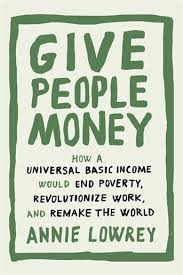
Annie Lowry describes UBI in her 2018 book “Give People Money: The simple idea to solve inequality and revolutionise our lives” saying, “Every working-age adult citizen would receive the same basic income payment every week. A smaller basic income, known simply as Child Benefit, will be paid for each child. Pensioners will receive a higher basic income, known as the Basic Pension.”

The idea of a UBI has floated in and out of political discussion from as far back as the 16th Century (of course it wasn’t then called the UBI) but has not found favour, however, times are different now.

Although not the most important issue, but seemingly the most prominent, we are headed for technological unemployment and under what exists people without work will be forced to rely on the government for an income.

According to economists at Oxford University about half of American jobs, including millions of white-collar ones, are susceptible to imminent elimination due to technological advances and history illustrates that Australians, and by implication those of us in the Goulburn Valley, are usually on a similar trajectory.

A legion of arguments can be amassed supporting a UBI and any counter-argument can be easily dismantled if people willingly, honestly and ethically allow facts to influence their thinking.
The UBI is about equality, sharing and decency and it is soaked in practicality and Robert Jameson writing in 
“The Case for a Basic Income”, said: “These cost savings would arise from the fact that basic income is an incredibly simple system to administrate, yet would be able to replace a huge swathe of complicated benefit systems currently in operation - and free us all from paying for the huge administration costs that go with them.”

Further, he wrote: “There would no longer be any need for sickness benefits paid to people who are unable to work. There would be no need for tax credits or 'universal credit' or income support. Incapacity benefit, carers' allowances, some (but not all) disability benefits, maternity allowances, child benefit, council tax benefit - no longer needed!”

Where does the money come from is the most common question, and that of course is not unreasonable.

The arithmetic for bureaucratic savings is obvious, but somewhat harder to detail are savings arriving from the broad betterment of people that arises from the lifting of the oppressive need “to keep a roof over our heads” and the willingness and ability of people to take risks (start a business) when their economic survival is underwritten.

Experience from around the world, especially in poor and developing countries, illustrates that to directly give people cash is clearly best as it is nearly always used to improve a person’s life, despite the odd miscreant who wastes the payment.

And as with the present drought there would no need for public aid for farmers, as we would have already “have their back”.

Taxation favours the few and so would need to be restructured to ensure all were treated equally.
 Interestingly, the UBI is not about tinkering around at the edges, rather a dramatic, game-changing simplification that offers, as Robert Jameson says, the real prospect of a genuine revolution in simplification, in efficiency and in the reduction of costly bureaucracy.

A short local and personal story - the little girl from my street, now no longer little as she has three children, one in his twenties, and is being treated for breast cancer.

She has to travel to Bendigo each morning for treatment after which, for economic reasons, she has to rush back to work in the afternoons. A UBI would avoid that crushing necessity in what is a truly difficult time. 


A UBI would allow her to escape that practicality and then, as an added bonus, allow for personal, intellectual and emotional freedom.

Saturday, October 24, 2015

Roaming brings many benefits both to individuals and communities


R

iding a bike was a skill learnt in the historic-fog of personal history.

Professor Trevor Hancock used
this image to illustrate the
advantages to a community
of "roaming" - advantages
now largely lost.
That relatively simple skill brought many bonuses and chief among them was freedom.

Suddenly the world was my oyster (well, the geographical wilds of Echuca east at least) and I was free to roam, pretty much at will.

That wonderful freedom allowed to myself and my friends was not considered much until recently when a Canada’s Professor Trevor Hancock talked about how stronger, resilient and healthier communities were when kids had the freedom to roam.

That roaming, he explained unintentionally informed kids about their community in that they got to know a variety of people, understand how it worked, its strengths, weaknesses and along with that understood and learnt much about themselves, all things that enriched them personally and aligned them, ultimately with the unstated aims of their community.

A pictorial image illustrated clearly how our roaming has been reduced to almost nil as the decades have passed taking with it an almost inexplicable sense of community that arose from kids roaming about the place.

The image illustrated that a kid of today could roam, unaccompanied, about 300 metres from his home; his mother less than a kilometre; his grandfather nearly two kilometres and his great grandfather regularly roamed about 10 kilometres to go fishing.

The visiting professor lamented the loss of roaming and was able to equate it with the decline in the broader wellbeing of community, suggesting that it illustrated, in a practical sense, our personal disconnect with nature.

Humans are unquestionably a part of nature and have long and rich history of being a part of it, until modernity really took hold.

Professor Trevor Hancock - he extolls the
community benefits of "roaming".
Humans have been hand-in-glove with nature for most of their existence, and many still are, but as Professor Hancock pointed out, we now spend 80 per cent of our time in a building, and so disconnected from nature, and of the other 10 per cent, half of that is spent inside a vehicle..

That disconnect from nature is now almost total and what is happening in the world indicates that such remoteness is bringing unintended consequences – we are almost absolutely insensitive to the impact our behaviour is having on earth’s climate system.

Roaming, of course is not the solution, rather just a small part of it.

The almost incommunicable health roaming brought to our communities appears to be lost forever as most people, reacting to the few stories given broad coverage in our popular media about isolated violent behaviour keep their children pretty much within reach, killing off their natural adventurous spirit.

Learning to ride a bike was about freedom and primed my willingness to engage with the other, a desire still with me today.

Saturday, May 16, 2015

Work is about wellbeing, a job is about profit


W

ork is integral to a person’s wellbeing. A job is not.

Work is something you choose to do; a job something to which you are directed to by another and so the matter of choice is no longer yours.

Therein is a small, but critical and significant difference.

Freedom is about choice and so as your freedom to choose goes, so does you actual freedom.

“Jobs, jobs, jobs,” has been the mantra of most, if not all, in their bid to secure public validation for personal political ambitions.

Everyone from the Prime Minister down chants what is a social more with the success of a society, or the government, being measured by the number of jobs created within that same society.

The drive and need to create jobs is further evidence of our social obedience to a way of life that has drawn its sustenance from the brutal mechanics of the Industrial Revolution and for centuries now has seen profit prioritised ahead of the welfare of people.

Our allegiance to the idea of jobs is evidence of what was at first a flirtation and then an affair to become a habitual way of life that meshes cleanly with the fundamentally contradictory consumerist idea that we can grow infinitely on a finite planet.

Jobs are intimately and intricately entangled with the growth economy, whereas work brings with it more ancient connotations; connotations that are about the provision of essentials; helping us find what we need, rather than want; jobs have a sense of mass production about them; work has an artisan affiliation, allowing for personal expression and a sense of satisfaction and fulfilment that is rarely experienced in our money driven society.

Jobs and our insistence on their creation, from the upper echelons of society, is about maintenance of the modern status quo, whereas work is about the ancient human need to contribute to your community and within that repair and rebuild your sense of self.


Confucius - "Choose a job you
love and you never work
another day in your life".
The difference between having work to do and a job is subtle, but such that it is a damning significance; a contrast that can distort human values to drive people to pursue ideas that would not have normally have attracted them.

Yes, jobs are the salvation of the modern profit-driven world and yes, jobs erode peoples’ expansive thinking and embrace of the other, while work does not until circumstances turn it into a job.

It was Confucius who said: “Choose a job you love, and you will never have to work a day in your life.”

And through a different prism: “Love the work you do and you will never have worry about finding a job.”

Our communities would be emotionally sounder and richer places if the emphasis was on work rather than finding jobs.

Sunday, September 29, 2013

Climate change is bring a decidely different future


Survival is going to
 need deep thought.
Tomorrow will be different from yesterday, no surprises there, but gone will be the status quo and many perceived freedoms.
 
Unmitigated climate change, a dilemma presently troubling the world, is something to which many are antagonistic for it brings with it the inevitable demise of most everything people in the developed world take for granted, especially imagined freedoms.

The discovery of fossil fuels along with the realization of and release of its embedded energy, set humanity on a troublesome trajectory that at first brought unimagined bonuses, but has now created equally unimagined complexities.

Humanity, interestingly, has the intellectual capacity equal to what is happening to our climate for when looked at analytically, it was our endeavours that unleashed the process, and now we understand the science.

So, we know what causes the difficulty and we know how to approach the solution, but the question is still, and it has never changed, are we intellectually bold enough, and sufficiently courageous, to implement the solutions we know exist?

The burning of oil, one of the prime causes of climate change, along with coal, suddenly saw those in developed countries, and other places to a lesser degree, freed from much physical labour as a barrel of oil represents more than 20 000 hours of human work.

Almost overnight many people went from being tied to the daily toil of sheer survival to a comparative life of luxury as oil, and coal, were put to work ending, largely, man’s drudgery.

This emancipation of our time wasn’t, sadly, put to figuring out how to husband this effectively free energy and so ration it rather, we wrongly assumed this was party-time and in about three centuries, we have nearly exhausted this rich resource.

Correction, it is unlikely we will ever exhaust earth’s fossil fuel resources rather our continued burning of them will disrupt human life to such an extent that we will no longer be able access or use them.

Freedom is an elusive smoke and mirrors concept, now you see it and now you don’t, and subsequent to the fallacy of the liberation promised by the military/industrial complex, we need to look to another freedom in which the needs of nature are equal to the wants of man.

Modernity has brought many advances allowing humanity to thrive, but within most enhancements has been an almost secret ideology that has gradually removed our freedoms, ensuring our behaviour enriches a relative few with most of the costs lumped upon the environment.

Should we value our freedom, then its survival depends almost entirely up us happily relinquishing some aspects or it.

The successful mitigation of climate change rests with you and me foregoing many traditional wants, readjusting our aspirations and understanding that genuine freedom is inextricably linked to discipline.

Sunday, July 31, 2011

Villawood riots escape my understanding

Few of those born in Australia understand what it was that recently drove asylum seekers in Villawood to the extremes of riot. I don’t.
I do know that they would be confused that a country portrayed as free, fair, democratic, liberal and generous appears to be few of those things.
Villawood rioters make
 their point in the only
way they can.
After months of waiting to see evidence of those claimed traits, those at Villawood, their patience exhausted, resorted to all a denied person has left, violence.
Reaction to the riots has been varied; some, who deserve our praise, have turned out in numbers to protest on behalf of those in Villawood and some have roundly condemned rioters, arguing they should simply be sent back from whence they came.
Considering the latter view, it is important to remember that these people came here in the belief, and hope, that Australia was a better place than that they left.
The riots suggests those beliefs and hopes have been dashed and so it is time we looked to our supposed qualities and considered whether they are real or imagined.
Shepparton has a strong history of assimilation of the other, of blending cultures and holding open the door to a better life, or at least a life that is secure and has promise.
Although that maybe the case in the Goulburn Valley, something some would argue about, those at Villawood see only promises denied, hopes dashed and security of the wrong sort.
A few things about people, whatever their race or culture, are constant, but their way of life embeds patterns of living and habits making them different and often that does not sit well with others.
It is a belief of mine that nothing is neither better nor worse, just different and so before criticizing Villawood rioters, we need to consider how we would behave if confronted by such striking differences.
Not only is life different in the extreme for the Villawood internees, the length of their imprisonment has little by little, drip by drip, eroded their hope.
So consider for a moment that life in your birth culture and country has, for various reasons, often beyond your control, become impossible and despite the threats and dangers to your wellbeing, you, brimming with hope, choose to get to Australia as best you can.
The journey made, the risks endured you arrive at your new home only to be effectively thrown in jail and the unspoken promises made by this wonderful, democratic and generous country prove to be an illusion.
Armed with only patience and civility you wait, and you wait, and yet the promised decency and democracy seems to be only for those walking free on the other side of the razor wire: what would you do? 

Friday, April 2, 2010

Atheism can ease the difficulties of a troubled world

I don’t believe in God, or gods; I don’t believe in luck, good or bad, I don’t believe in things being fair or unfair; I don’t believe in supernatural entities or happenings; and nor do I believe in the many superstitions that presently wrench at our world.
However, I do believe that it is “the believers” in these fanciful fantasies, and act on them, who are at the root of what troubles humanity.
It unsettles me that many have what appears to an uninhibited belief in such things as peace, equality, sharing, honesty and integrity but pressed, for whatever reasons, quickly abandon those values to become a “raw” person operating on base human survival instincts.
Attendance at the recent 2010 Global Atheist Melbourne Convention illustrated that atheism is more than the adherence to the belief that God, or gods, do not exist as at its core, atheism is about freedom – freedom of religion, freedom from religion, freedom of speech, freedom of choice and freedom from superstition.
We die for perceived freedoms; atheism delivers them all at no more cost than how you think.
Atheists, just like those believers in those things I’m uncomfortable about, are mostly decent people. Naturally, in whatever circles you mix, you will find people who don't equate with any understanding of moral correctness.
I do believe in anything that is measurable and understandable, while the faith that gods, supernatural happenings or superstitions demand adherence to qualities that defy rationality, empiricism and reason.
Nothing is fair or unfair, rather it just “is”; luck is neither good nor bad as all circumstances that lead to whatever has happened can be explained.
An accident of more than a decade ago opened death’s door and so to simplify the conversation, some say I was lucky to survive – it wasn’t luck, rather it had to do with exactly what happened in the accident, excellent subsequent medical attention and then the follow-up help and advice.
Does my atheism make me a better or worse person? Not necessarily either, but I identify with Hypatia of Alexandria who said: “All formal dogmatic religions are fallcious and must never by accepted by self-respecting persons as final"