Friday, July 5, 2019

Funerals are markers in our lives, and that of communities

Attending funerals and recording the names of mourners was among the early tasks for a junior reporter, and friend, who worked at this newspaper as a sub-editor before returning to his home in England.

A list of mourners would probably not make good reading unless that list was personally important in that underlined, or said something about the standing within the community of the person being buried.


Funerals are markers in our lives, and that of communities.

Funerals are fascinating affairs, bringing together a disparate group of people from lovers, family, friends, work colleagues, enemies, advocates, the local who is “at everything”, and the occasional character who can’t wait for the formalities to end and the free food of the wake to begin.


However, they can also be a learning experience with tales told during the eulogy revealing a whole new aspect to the life of the person  being buried.


Some things are alarming, some are ridiculously funny and some help you better understand why things are the way they are and within that explain something about history, particularly the era through which the soul being celebrated lived.


A near 90-year-old aunt was buried in Echuca recently and the stories of her life evoked a host of memories, among them what a wonderful story teller she was.


Nothing was ever missed and within a flash, a riveting and almost scary tale about a police escaper crashing through the backdoor could change to a side-splitting story, without interrupting the original story-line, about burning the breakfast toast.


It’s worth retelling a little about the fellow running from the police, he burst into my aunt’s house with the police in close pursuit, my aunt and her husband retreated to a bedroom, while the police and the villain crashed about the house, pepper-spray was involved and the arrest took some time until the four or five police officers finally cornered and subdued the escaper.


That story had a certain vigour and it was re-energised in every telling by my aunt, but that was just one story from the week as it was only as few days later that a rogue bull escaped from the city’s sale yards and ended up in my aunt’s yard.


Soon after, some people searching for the bull arrived, shot it and it died in my aunt’s driveway. Those stories weren’t told at the funeral, but my aunt told them with such colour, detail and shrieks of laughter that they are fixed my memory.


Funerals are frequently life-markers, both for individuals and communities.


There is alway pre and post funeral memories and beyond that, it seems they say something about your inclusion in whatever community you call home.


St Arnaud in central west Victoria was my home for about two years in the early eighties and although my family and I enjoyed our time there, never did I feel sufficient connection with anyone to attend a funeral.


Having moved to Shepparton from St Arnaud and lived here ever since, I now attend two or three funerals a year, although I am getting older and so friends and other community colleagues are dying with an alarming regularity. 


Attendance at a funeral, beyond immediate family and friends, has always seemed to me a marker of your arrival as a “local”.

Friday, April 19, 2019

And the elephant wasn't even in the room at Mooroopna drought summit

The elephant, it seems, wasn’t even in the room during the recent Drought Summit at Mooroopna.
Federal Agriculture Minister, David Littleproud.
However, the Federal Agricultural Minister, David Littleproud, the Drought Envoy, Barnaby Joyce and the Federal Member for Murray, Damian Drum, and about 100 agitated others were.

Sadly, I wasn’t there, but inquiries suggest that had the elephant turned up, it would have been turned away as the thought that we had caused the troubles that malign the lives of our farmers did not have much currency among those in the room.

Australia, like the rest of the world, is barrelling down the climate change highway.

Most everything the climate scientists predicted has and is happening, but with one significant difference; it’s unfolding somewhat quicker than envisaged. Yes, the abyss is almost visible.

There was, according to reports, a widely held view at the drought summit that the water shortage compounding the troubles of our farmers was a “man-made drought”, meaning the country’s water resources had been badly managed.

Such conversations are little more than a distraction from the real game, the fact that our disrupted climate system has changed weather patterns and the reality is that we get less rain where we need it and more where we don’t.

And when we do get it, it comes in great bursts, quickly runs off, leaving a scant amount to soak in, and as it vanishes so does some of our rich and valuable top soil. The long-term benefit fo that downpour is damnably slim.

The Intergovernmental Panel on Climate Change (IPCC) knows about the elephant and in it latest report outlines the climate effects of 1.5ºC and 2ºC warming and discusses the efforts that will have to be taken to hit those targets; targets that current emissions-reduction pledges get us nowhere near where we need to be. 

The IPCC said our transportation, land-use, building, energy, food, and other systems need to be redesigned from the ground up to reduce emissions and prepare for a warmer world.

Drought envoy, Barnaby Joyce.
The conversation we must have to prepare for that warmer world is not one Minister Littleproud, Drought Envoy Mr Joyce, or local Member, Mr Drum, are willing to initiate as the essence of where the discussion must go contradicts their fundamental political ideologies.

It was only a week ago that the leader of the CSIRO’s Earth Systems and Climate Change hub, Dr David Karoly, who is known to many in the Goulburn Valley, echoed an earlier comment when he said Shepparton was inline for successive days of 50 degrees Celsius.

Those temperatures combined with a drought, man-made or otherwise, will force acknowledgement of that elusive elephant and with it serious discussion about seeing Australia embrace the idea of a “climate emergency”, something now being discussed by Britain’s House of Lords.


And while we contemplate that idea, it is interesting to note that Australia, according to the Bureau of Meteorology, has just left its hottest March on record.

Saturday, January 19, 2019

Living in news vacuum, yet living in a real world

Many kids live in something of a news vacuum.

Some will cheer and whoop in support of that idea, others would be equally critical of such parenting, reflecting pretty much any position taken in life about most anything.

Backers of the idea argue that young and innocent kids should not have the graffiti of news scribbled on the blank slate that is their nascent minds.

Such a position sadly fails to acknowledge the instinctive resilient capacities of the young and adds only what weight to any issue as to how it is framed by those older people around them.

The idea that in blocking out the news of the day as a way to protect children is really little more than parents refusing to personally engage with the events of the day and so play a key role in helping their children understand whatever is happening and put it in context.

Helping your children understand the news of the day, the news of the world is among one of parenting’s prime tasks.

Inexplicably, at least to me, the same parents who create that factual news vacuum in the name of protecting their children, allow those same kids embrace the most perverse fictions.

Writing in his 2018 book, “Fictions of Sustainability: The Politics of Growth and Post-Capitalist Futures”, Boris Frankel said: “Now, countless children are raised on a diet of blockbuster disaster movies, speculative dystopias and computer games featuring the collapse of civilisation brought about by terrorists, aliens, environmental catastrophes, unstoppable pathogens and other ‘monsters’ of the commercial imagination.”

Apparently, for many kids it is OK to have their behaviours distorted by the products of that “commercial imagination”, but reality is a no, no.

Fortunately, our schools adhere to the facts and even those which engage in the pursuit of fanciful distractions do take their young students on exploratory mental expeditions, allowing them to bivouac in learning places ensuring the expansion of their thinking, helping them better understand the real world.

The arm wrestle between market-driven imaginary mutations and fact-driven realities favours the latter as illustrated recently when thousands of students from across Australia went on strike to protest our government’s inaction on climate change.

The students understand and accept the irrefutable realities of climate change, illustrating that the thousands of striking teenagers had not been locked in a news-free bubble, but were in fact much more aware of what is happening than our dismissive government.

Late last year, The Guardian newspaper reported: “The science is clear, the facts are incontrovertible, and it is unconscionable to us that our children and grandchildren should have to bear the terrifying brunt of an unprecedented disaster of our own making”. 


The news aware students simply know and understand this reality and their schools should be congratulated for encouraging such learnings and parents who ensured and embraced these realities also deserve praise.

A wicked problem defies contemporary or traditional solutions

A wicked problem is one which worsens when subjected to contemporary or traditional solutions.
The Queensland bushfires gave us
some remarkably unusual scenes.

Here in Shepparton, we were comfortably geographically remote from the hitherto unseen bushfires in Queensland, but metaphorically living next door in a climate-changed world.
The fires that were unquestionably aggravated by our disrupted climate system and many even say “caused”.

The solution, interestingly, was to fly firefighters and equipment in from all around the country using fossil-fuelled energy sources that further enrich the damage caused by a conflagration with their direct links to climate change.

And so the fires caused by climate change - not at all, according to the business a usual brigade, or almost totally in the minds of climate change advocates - fell directly into the “wicked” realm as in fighting them, that’s the solution, we added significantly to Australia’s carbon dioxide emissions.

Let’s accept for a moment we are facing a wicked problem (we are), but that is rather difficult to grasp here in Shepparton as life appears OK, beyond, that is, a striking absence of rain and severe temperatures.

The Goulburn Valley has fortunately avoided, certainly, of late, the headline-grabbing climate change-driven events that have brought catastrophes to many communities throughout Australia, and the world.

Writing in “Defiant Earth: The fate of humans in the Anthropocene” the Australian author and public intellectual, Clive Hamilton, said, “The greatest tragedy is the absence of a sense of the tragedy”.

The Professor of Public Ethics at Canberra’s Charles Sturt University, said: “The indifference of most to the Earth System’s disturbance may be attributed to a failure of reason or psychological weaknesses; but these seem inadequate to explain why we find ourselves on the edge of the abyss.”

Interestingly as some sort of hint, the America news website has said that: “It’s almost easier to despair or to will oneself into ignorance than to begin to grapple with the future”.

During a recent discussion, it was suggested that the way ahead, the way to deal with this wicked problem, was to embrace meekness, and idea that contradicts the essence of the capitalist economic system that champions aggression.

And turning again to Clive Hamilton, he points out that the forces we hoped would make the world a more civilized place – personal freedoms, democracy, material advance, technological power – are in truth paving the way to its destruction.

Albert Einstein’s suggestion that madness was doing the same thing repeatedly an expecting a different result seems to equate with the solution to the Queensland fires - using fossil fuel powered devices to solve a problem caused by a disrupted climate system that has been primarily unsettled by humans dumping excessive amounts of carbon dioxide into the atmosphere.

A Yale professor of law and psychology, Dan Kahan, says climate change had become a symbol of whose side you are on in a “cultural conflict divorced from science”.


That adds to the wickedness of the problem and so one solution is the immediate change in our behaviours to encourage adaptation, along with a more restrained way of living.

Joining me at the launch of the book “Degrowth in the Suburbs”.

You, dear reader, joined me at the recent launch of the book “Degrowth in the Suburbs”.

Well, you were not actually there in person, but it was such an important moment that I took you along in spirit.

Why did I bother? 

The book, the work of Samuel Alexander and Brendan Gleeson, gives a clear understanding the difficulties arising from the energy-intensive economic system that prevails here and points to the need for altered behaviours if we are to avoid a collision with resource shortages and climate extremes.

Dr Alexander, a co-director of the Simplicity Institute and a lecturer at the University of Melbourne’s Office of Environmental Programs, co-wrote the book  with the Director of the university’s Melbourne Sustainable Society Institute, Professor Gleeson.

Interestingly, I have been an advocate for the densification of Shepparton and so rather than allowing, or encouraging the city, to spread in what I consider a haphazard manner into adjoining farmland, we should be restructuring the city’s rating system to make densification irresistibly attractive to developers.

However, Alexander and Gleeson were not enthusiastic about densification as we first must learn to live with a built infrastructure that will be an integral part of a towns and cities, suburbs in particular, for many generations yet.

In an interview just last week, Alexander said everything needs to be taken in context and it was dangerous to make sweeping generalisations about what is an inherently complex problem, but he said it may well be appropriate to consider a degree of densification for Shepparton.

Most of Shepparton’s infrastructure has existed for about a century and so what we are building now will have to endure whatever it is the next 100 years will bring and having listened to Alexander and Gleeson, we need to think carefully and deeply about what we build, why we build it and where we build it.

And in their book, the authors point to a “crunch” moment when there will be a collision between the world’s finite resources and human aspirations, and if not within the next few decades, then most certainly before this century is over.

Degrowth in the Suburbs is not a cheap book, something for which Professor Gleeson apologized during the launch noting that it was problem of contemporary publishing, but people here will have the chance to read it soon for free when a copy is secured by the Shepparton library.

Dr Alexander is an example to us all as his way of living, which by today’s standard is austere and yet according to him complete, rich and happy, is about sharing, living with just enough and being dependant wherever possible on renewable energy, growing his own food, and investing himself in his neighbourhood.


The work of Alexander and Gleeson allows a glimpse of the future, suggests what our response should be and, in a charming way, gives us hope. 

Wednesday, October 17, 2018

Measuring success is easy, especially if we apply contemporary values

Success in Shepparton can be measured easily, certainly if we apply contemporary values.

In fact success anywhere is easily gauged if we apply assessments that have catapulted humanity to the point were it stands astride the world.

Yes, busyness driven by the exploitation, sometimes knowingly and others not so, of human nature has given us so many wonderful things, but left us teetering on the edge of the abyss.

There is another way.

Idleness appears integral to who and what we are and yet any suggestion that it be enthusiastically embraced brings scorn, derision and laughter as we are so conditioned why a life of work, accumulation, ambition and pleasure arising from what is considered success that we are unable, it seems, to contemplate anything different.

However, writing in “Idleness; a philosophical essay” Brian O’Connor said: “A more stable and less ambitious socioeconomic system could possible save us from some of the more familiar perils of modern life”.

Already, before writing another word, I can hear the chorus of complaints from those addicted to a life of busyness, who see success only in achievement and living a life diametrically opposed to idleness.

Much of what we enjoy today, they would argue, only exists because of efforts of those who were engaged, busy and constantly pushing to improve things, make them better and wherever and whenever possible allowing people to live an easier and trouble free life. 

And, of course, there is lots of sense in what they say, but, as most know, a trouble free life is a mirage.

Many conflate idleness with pleasure, but they are in fact different and as O’Connor says pleasure is eventually expended, it cannot form the basis of any long-term way of life, whereas idleness allied with virtue has a certain endurance.

Busyness became embedded in our lives after the neoliberal seed planted in the first half of last century and  then flowered in latter decades when those playing the long game manufactured a few crises to suggest that what existed was failing and the philosophies that drove, among other things the monetisation of everything and privatisation of the publicly owned infrastructure, was the only way.

The resultant busyness produced many things, among them an inequality of a like the world has never seen before as it can be shown that just a few more than 60 individuals control more wealth than 3.5 billion people.

Interestingly, inequality carries its own seeds of destruction.

Although that inequality could bring social or revolutionary changes another even more destructive process, which has arisen from this obsession with wealth, control and power, is afoot - it’s the disruption of our climate system bringing changes to our weather of a type never before experienced.

Where does idleness fit in with this? 

Well, it seems that virtuous idleness allows time for reflection and strips us of our energy-rich behaviours that are pushing our world closer to circumstances about which we know little. 


And so what does that mean for Shepparton? For a start we should embrace idleness, step back from the previous PM’s mantra of jobs and growth, consume less, detach ourselves from our energy-rich lives and encourage our city council to follow the lead of their Melbourne counterparts, the City of Darebin, which has formally adopted a climate emergency strategy.

Thursday, September 6, 2018

Freedom is a fickle thing, but the UBI can help us experience emancipation

Freedom is a fickle thing, little understood by most and seldom experienced by many.

Imagined freedom for some is just that for the for the daily vicissitudes of the economy limit their behaviour and so remove the spontaneity that is fundamental to emancipation.

And that sociological control, the removal of our human spontaneity, is the unspoken goal of the power regimes in society whose control rests with people not understanding or experiencing real economic freedom.

We are all working for “the man” and history has shown, repeatedly,  that “the man” doesn’t like spontaneity or genuine freedom among the people and so will crush it whenever and wherever it appears.

And so the freedom we imagine and pine for in not being economically obliged to dance everyday to the fiscal tune of an inherently flawed systems; systems that favour just a few and disenfranchise the rest, can be found through a Universal Basic Income (UBI).

Australia is rich beyond imagination, although political rhetoric tells us otherwise and despite the political carping, we are ideally placed to simply give people money and so that is where the UBI comes in.

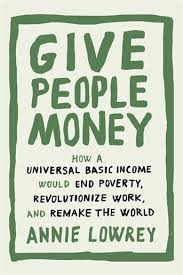
Annie Lowry describes UBI in her 2018 book “Give People Money: The simple idea to solve inequality and revolutionise our lives” saying, “Every working-age adult citizen would receive the same basic income payment every week. A smaller basic income, known simply as Child Benefit, will be paid for each child. Pensioners will receive a higher basic income, known as the Basic Pension.”

The idea of a UBI has floated in and out of political discussion from as far back as the 16th Century (of course it wasn’t then called the UBI) but has not found favour, however, times are different now.

Although not the most important issue, but seemingly the most prominent, we are headed for technological unemployment and under what exists people without work will be forced to rely on the government for an income.

According to economists at Oxford University about half of American jobs, including millions of white-collar ones, are susceptible to imminent elimination due to technological advances and history illustrates that Australians, and by implication those of us in the Goulburn Valley, are usually on a similar trajectory.

A legion of arguments can be amassed supporting a UBI and any counter-argument can be easily dismantled if people willingly, honestly and ethically allow facts to influence their thinking.
The UBI is about equality, sharing and decency and it is soaked in practicality and Robert Jameson writing in 
“The Case for a Basic Income”, said: “These cost savings would arise from the fact that basic income is an incredibly simple system to administrate, yet would be able to replace a huge swathe of complicated benefit systems currently in operation - and free us all from paying for the huge administration costs that go with them.”

Further, he wrote: “There would no longer be any need for sickness benefits paid to people who are unable to work. There would be no need for tax credits or 'universal credit' or income support. Incapacity benefit, carers' allowances, some (but not all) disability benefits, maternity allowances, child benefit, council tax benefit - no longer needed!”

Where does the money come from is the most common question, and that of course is not unreasonable.

The arithmetic for bureaucratic savings is obvious, but somewhat harder to detail are savings arriving from the broad betterment of people that arises from the lifting of the oppressive need “to keep a roof over our heads” and the willingness and ability of people to take risks (start a business) when their economic survival is underwritten.

Experience from around the world, especially in poor and developing countries, illustrates that to directly give people cash is clearly best as it is nearly always used to improve a person’s life, despite the odd miscreant who wastes the payment.

And as with the present drought there would no need for public aid for farmers, as we would have already “have their back”.

Taxation favours the few and so would need to be restructured to ensure all were treated equally.
 Interestingly, the UBI is not about tinkering around at the edges, rather a dramatic, game-changing simplification that offers, as Robert Jameson says, the real prospect of a genuine revolution in simplification, in efficiency and in the reduction of costly bureaucracy.

A short local and personal story - the little girl from my street, now no longer little as she has three children, one in his twenties, and is being treated for breast cancer.

She has to travel to Bendigo each morning for treatment after which, for economic reasons, she has to rush back to work in the afternoons. A UBI would avoid that crushing necessity in what is a truly difficult time. 


A UBI would allow her to escape that practicality and then, as an added bonus, allow for personal, intellectual and emotional freedom.